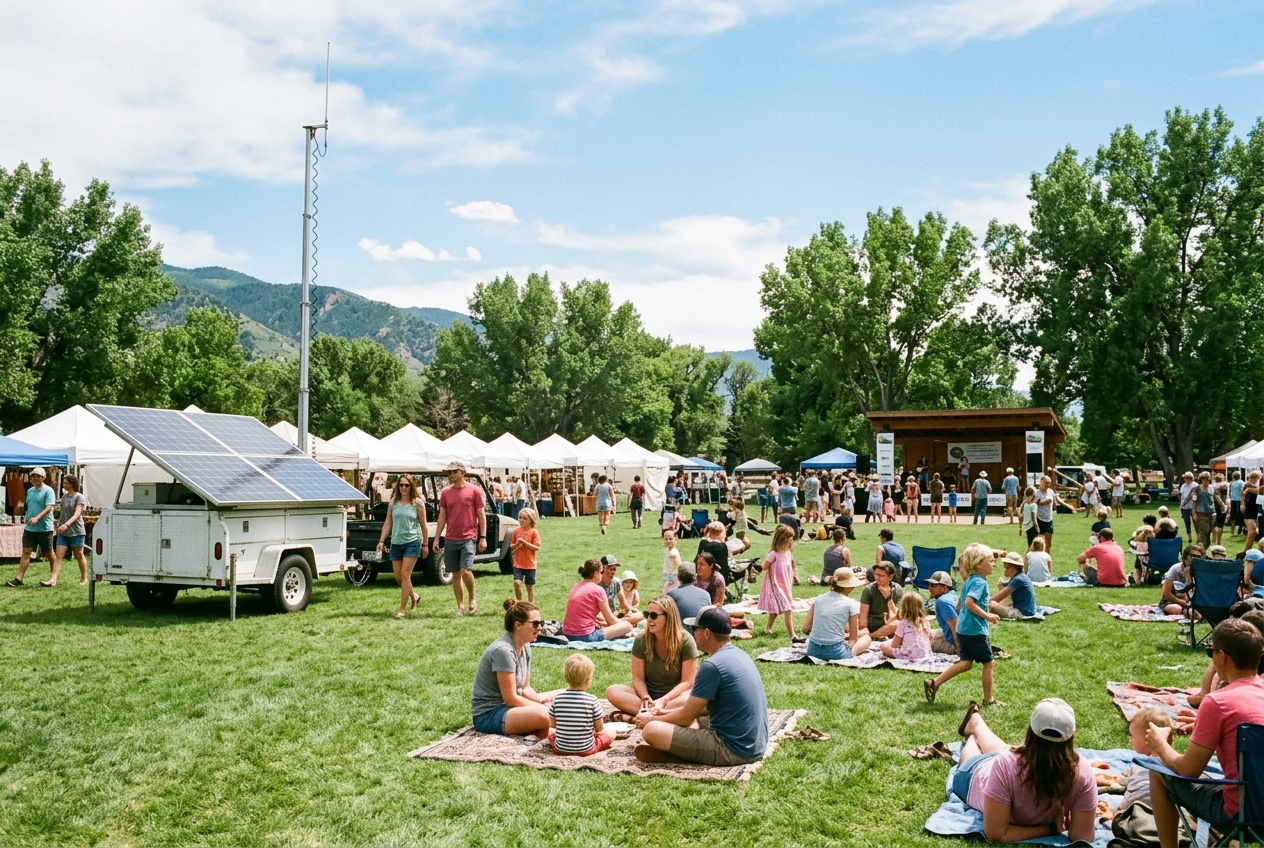
Saturation
Events & venues
Ten thousand phones in one field will bring a carrier cell to its knees before the headliner goes on. Vendors can't run cards, staff can't reach each other, nobody's posting.
Mobile telecom · Serving all of Colorado
A solar-powered trailer carrying WiFi 6/7 access points on low-earth-orbit satellite backhaul. No fiber, no cell tower, no grid power. We roll in, stand it up, and stay until you're done — festival fields, incident command posts, job sites, and the valleys the buildout skipped.
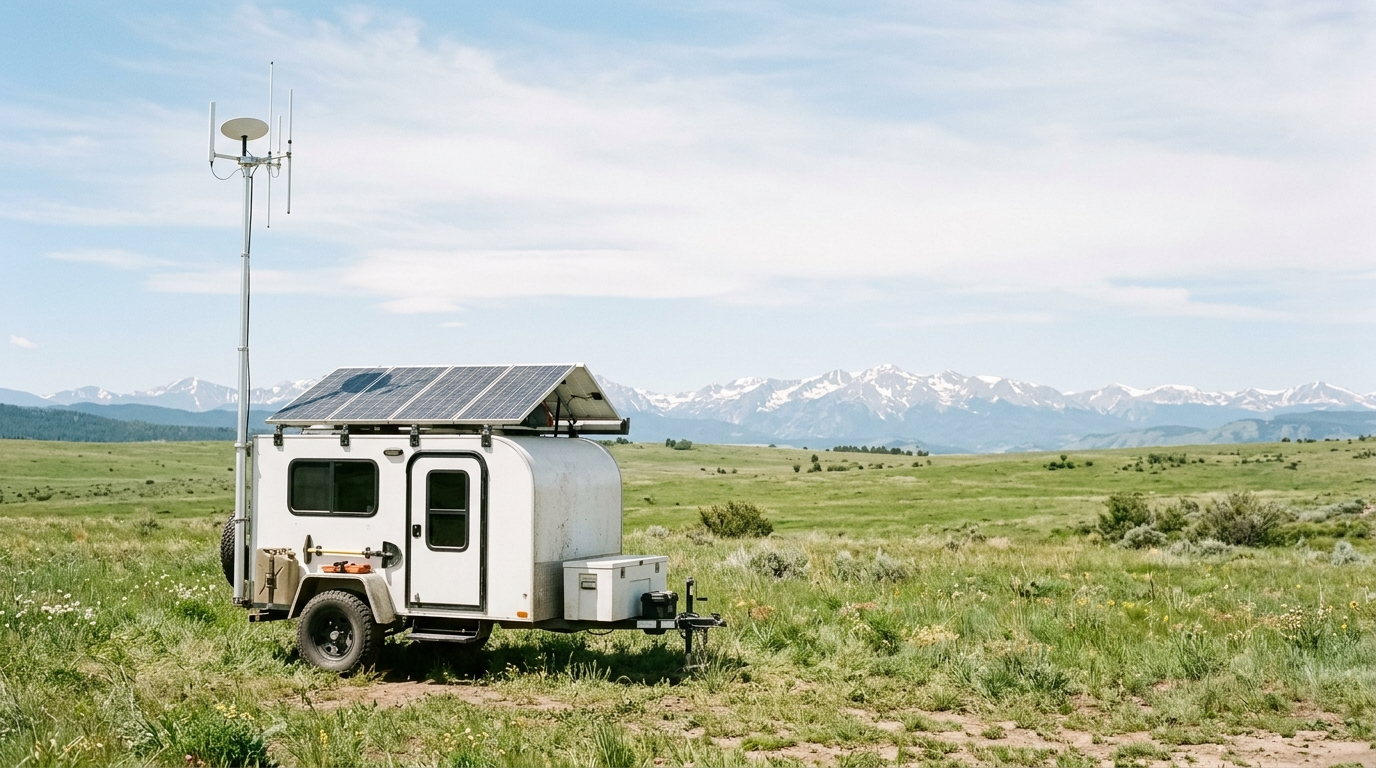
Where we deploy
Coverage maps get drawn for an empty field on a clear day with nobody else on the tower. Real sites never look like that.
Ten thousand phones in one field will bring a carrier cell to its knees before the headliner goes on. Vendors can't run cards, staff can't reach each other, nobody's posting.
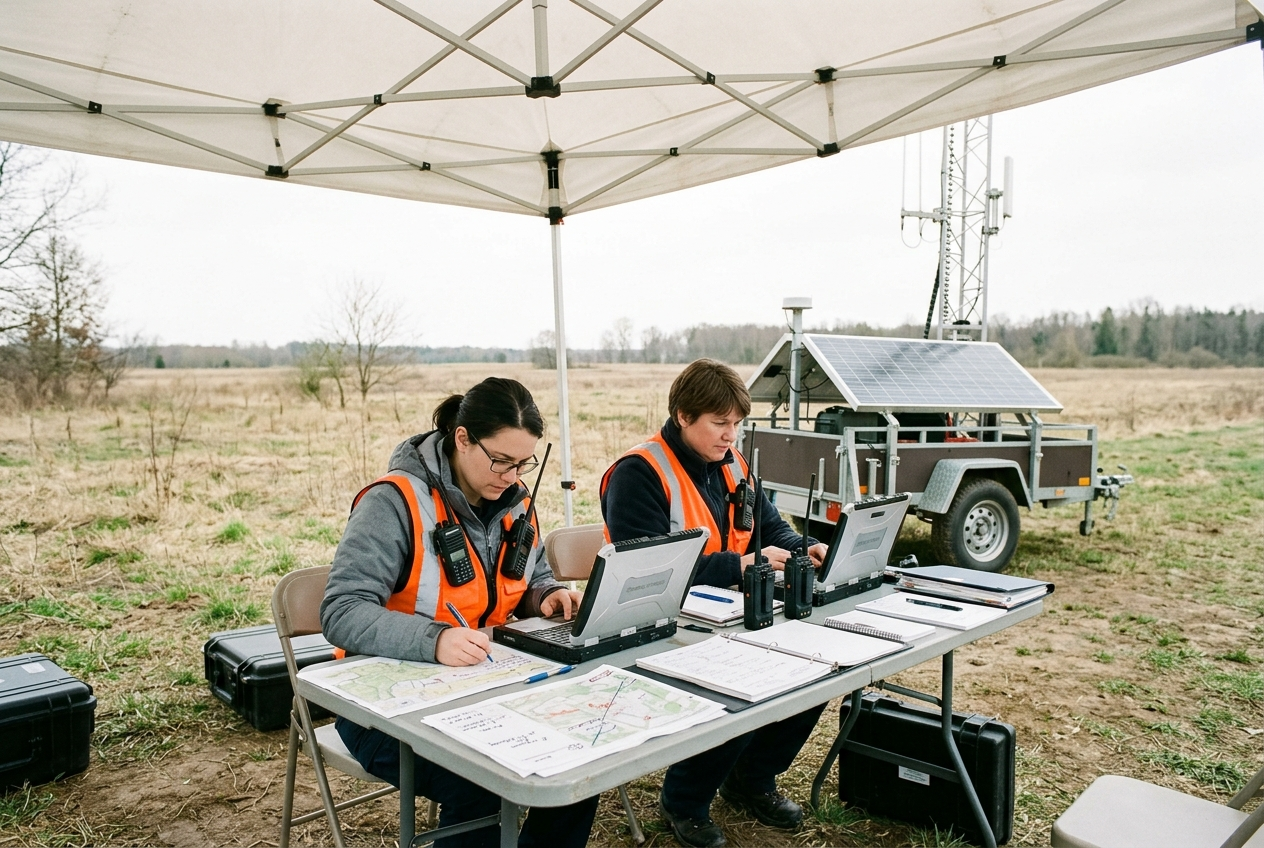
Fire, flood, and long outages take towers with them. Command posts and shelters end up running on whatever somebody's hotspot can hold, right when the stakes are highest.
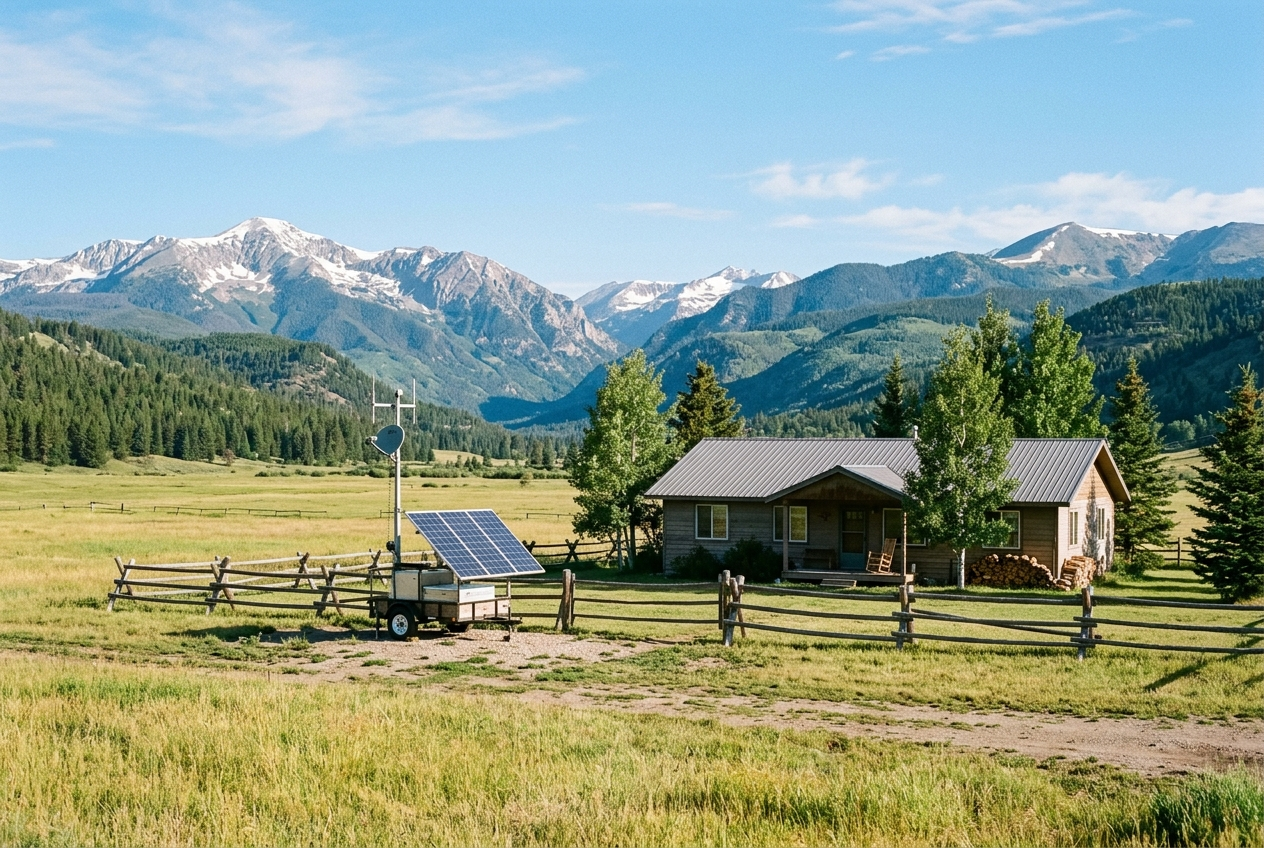
Terrain stops trenching. Whole valleys, plains towns, and work sites sit outside the fiber map and always will, because the math on the last mile never closes.
The breakdown
No install window measured in weeks, no contractor scheduling, no trenching permit. Three steps between your call and a live network.
Send the dates, the location, and roughly how many people. We look at sky view, tow access, and terrain shadowing. If a site won't work, you hear that from us up front rather than on the day.
We tow it to the staging point, level it, raise the mast, and the dish acquires. Your network name is broadcasting while the rest of the site is still being set up. Nothing is asked of your crew.
Throughput and client counts get watched for the whole run, not checked once and forgotten. If something degrades, it gets fixed on site. We break down when you do.
The unit
Backhaul, power, and access layer all built onto one trailer, so the site doesn't have to provide anything but ground to park on.
Size my site
Move the sliders to your real numbers. It's a planning estimate, not a quote — but it will get you close enough to budget from.
Assumes roughly 1,500 concurrent clients per unit. Heavy video or payment traffic lowers that; a mostly-idle crowd raises it.
What comes with it
Mud, altitude, wind, no shore power, and a hard start time. That's the normal case, not the exception.
Low-earth-orbit, so latency stays usable for calls and card readers instead of the half-second lag of older satellite service.
Solar and battery carry the unit through a multi-day event with a generator held in reserve. No shore power, no fuel run mid-show.
WiFi 6/7 access points tuned for crowds, where hundreds of clients fight for airtime in the same few hundred feet.
Command traffic can be split onto its own SSID and VLAN so public browsing never competes with the people running the incident.
Your name, your sponsor, your terms of use on the join screen. The network becomes part of the event instead of a utility nobody sees.
A number that reaches a person, not a queue. If the network has a problem at 11pm on day two, that's the whole reason you hired a mobile unit.
What we don't do. We're not your ISP and we don't sell two-year contracts. We won't promise a speed we haven't measured at your site, and we won't take a booking for a location where the sky view doesn't support it. If your venue already has capable fixed service, we'll tell you that instead of selling you a trailer.
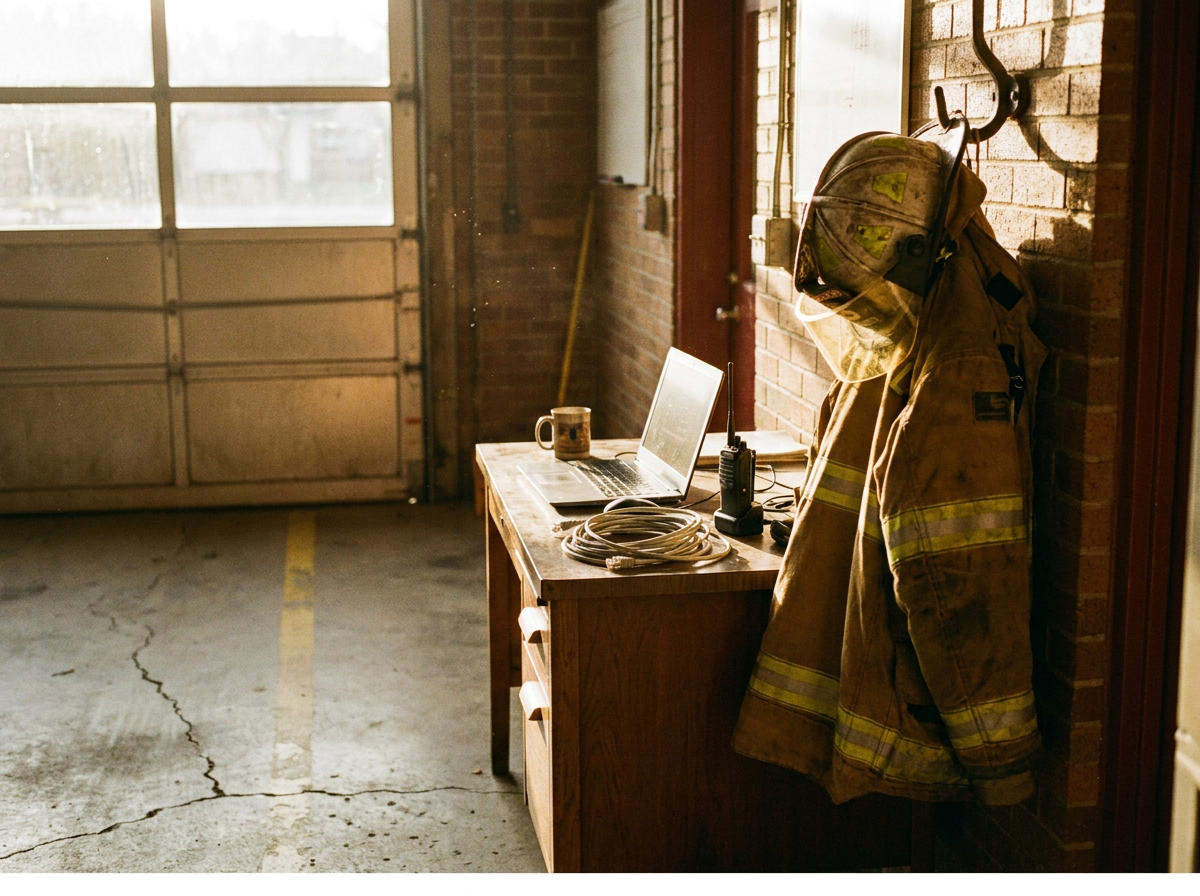
One man on a mission
Colorado WiFi is run by a former professional firefighter with two decades in emergency response, search and rescue, and large-scale safety operations. That's not a marketing line — it's why the response standard is what it is. Emergency work teaches one habit above all others: when the call comes in, you go, and you show up with the equipment already loaded.
“Somebody dialed. Somebody came. That's the whole job — it just used to be a fire engine.”
Rodney · Founder, Colorado WiFi
Book a unit
Send the site and the dates and you'll get availability and a flat quote back — not a discovery call. Booking an event? Earlier is better; one unit can only be in one place at a time.